Quick Verdict
Pros
- VoIP can be cheaper than traditional business voice services, but the result depends on seat count, included calls, hardware, features, broadband and support. Compare itemised, like-for-like quotes.
- Features such as auto attendant, ring groups and call recording are available on many hosted systems, but inclusions and additional charges vary by provider and plan.
- Geographic, 1300/1800 and some international numbers may be available, depending on the provider, plan, country and porting eligibility.
- Cloud systems can often add or remove users without replacing an on-premise PBX, although additional licences, handsets, network capacity or call channels may be required.
- Works over many internet services, including NBN, provided the connection has adequate bandwidth, latency, jitter and packet-loss performance and the network is configured for the service.
Cons
- Dependent on internet connection quality. FTTN NBN can cause quality issues
- Requires power at the premises (desk phones need PoE or power adapters)
- Emergency services (000) location accuracy can be less precise than PSTN
- Setup and number porting requires some planning time
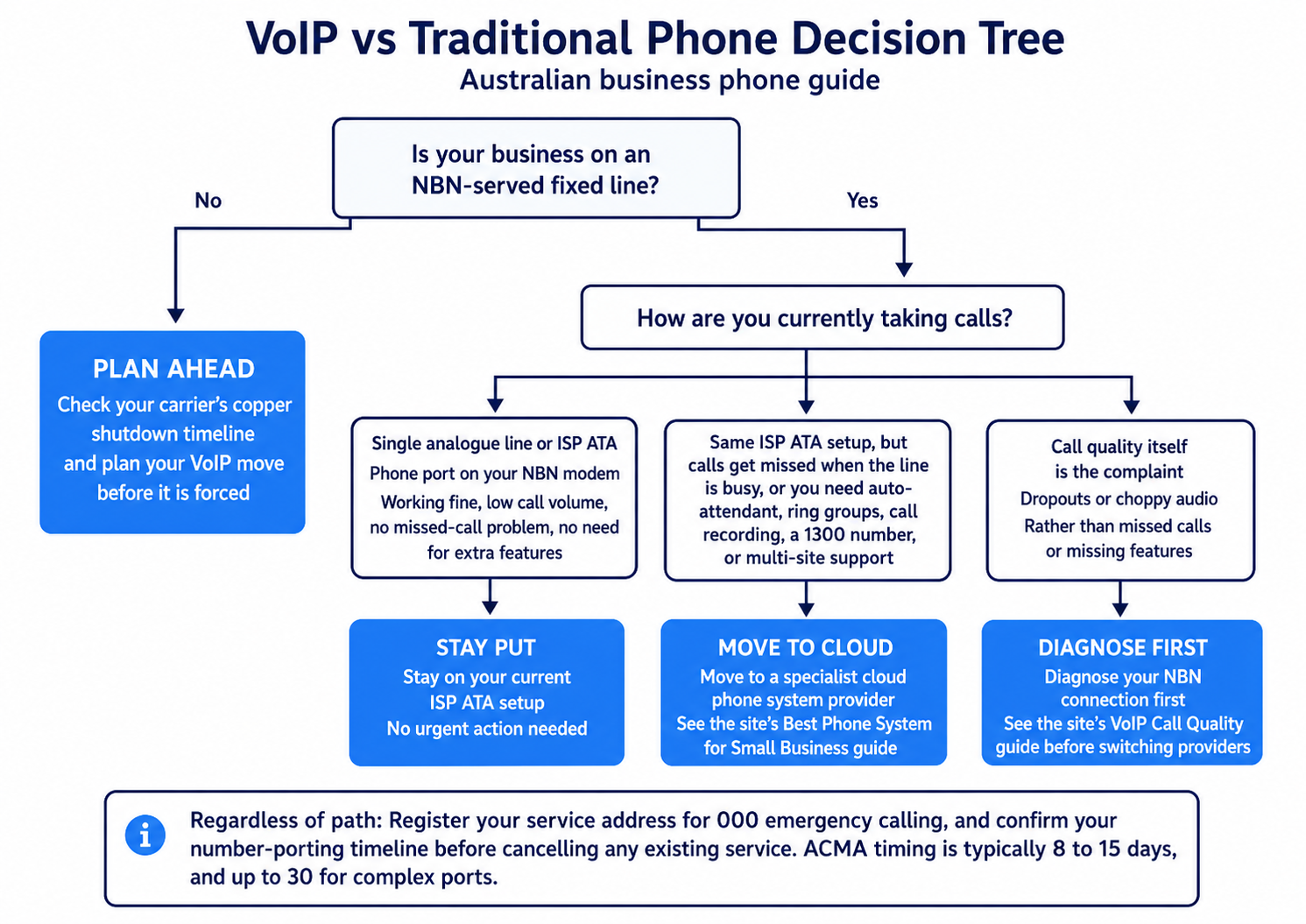
The PSTN Copper Shutdown: Why This Decision Is Largely Made
This guide gives you a direct, honest comparison between VoIP and traditional phone systems for Australian businesses, including real cost breakdowns, NBN call quality realities, and the practical trade-offs that matter. Written by an independent editorial team with direct experience in business communications infrastructure, not by a provider trying to sell you a plan. By the end, you will know which option fits your business and exactly what switching involves.If your business is in an NBN-served area and you are still on a traditional landline, you may already be operating on a service that is scheduled for shutdown. The practical implication is that most Australian businesses choosing between VoIP and traditional phone are not comparing equal alternatives. Traditional PSTN landline is not available in most NBN areas. The real choice is between different VoIP approaches: cloud phone system, on-premise PBX with SIP trunking, or unified communications platforms. Check the exact Telstra product. Telstra Wholesale CTS exits on 30 September 2026, while Telstra lists an August 2027 exit for T-Biz Voice and Digital Office Technology; these dates do not apply to every Telstra SIP or inbound service.The NBN Silent Migration
When Australia rolled out the NBN, internet providers moved millions of homes and businesses from traditional phone lines to VOIP via the phone port on their modem. Affected fixed-line premises were generally notified and given a migration period, usually around 18 months, although the clarity and effectiveness of individual provider communications may have varied. Customers could often keep using the same handset experience and number, but equipment, plans and billing depended on the provider and migration arrangements. But the underlying technology changed completely, and customers lost control of their phone service in the process.The result is a national knowledge gap. Australian households and small businesses may use VoIP through a phone port on their ISP-supplied modem or adapter without necessarily being familiar with the underlying technology or available alternatives. If you are in this situation, you are not behind. Many customers may not understand that an NBN modem phone port uses VoIP, but the article provides no evidence that the industry deliberately concealed this. Understanding what you have is the first step to fixing it.Cost Comparison
| Traditional PSTN (legacy) | VoIP cloud phone system | |
|---|---|---|
| Monthly line rental (per seat) | $40-80/month | $20-50/month |
| Local calls | Often included or flagfalling | Usually included or per-minute |
| National calls | Flagfall + per-minute | Usually included or low per-minute |
| Mobile calls | Often 20-40c/min | Often 8-15c/min or included |
| PBX hardware | Varies substantially with the PBX appliance, licensing, handsets, cabling, installation and support requirements. | Nil (hosted) or hardware only |
| Maintenance | On-site technician required | Provider handles remotely |
| Adding a line | $100+ installation + new hardware | Provision in the portal, ship a phone |
Call Quality: Honest Assessment
Traditional PSTN calls have consistent, predictable quality because the circuit is dedicated to your call. VoIP call quality depends on your internet connection and network configuration. VoIP can provide wideband audio using codecs such as G.722 when both endpoints and the intervening call path support it; FTTP or FTTC alone does not guarantee wideband quality. The issue is that not all Australian businesses have ideal NBN connectivity.FTTN can be affected by faults or limitations in its copper segment, while latency and packet loss may also arise from local networking, ISP capacity or other parts of the call path. FTTN performance can be affected by its copper segment, but a higher speed tier alone does not guarantee call quality. Check line performance and faults, local QoS, ISP design and whether an FTTP or business-grade traffic-class option is available. Our VoIP call quality guide covers this in detail.Congestion and CVC: NBN removed CVC (Connectivity Virtual Circuit) overage charges for fixed-line and fixed-wireless services from 1 July 2026. Congestion can still occur during periods of high network demand, whose timing varies; the ACCC’s residential busy-period reporting uses 7-11pm, since CVC capacity is aggregated at a connectivity serving area and point of interconnect rather than a single local node. This can still affect VoIP call quality even if your line speed is fast. Whether a business-grade NBN plan reduces this risk depends on the specific plan and provider, check for any stated service-level commitment rather than assuming a business label guarantees priority. Our call quality guide covers diagnosis and fixes in detail.Features Comparison
Once you've decided VOIP is the right direction, the actual handset still matters for busy desks. See our comparison of Yealink's T7 series phones if reception or an executive role needs more line capacity than a standard desk phone provides.
| Traditional PSTN | VoIP cloud phone system | |
|---|---|---|
| Auto attendant (press 1 for sales) | Requires expensive hardware | Included in most plans |
| Ring groups | Hardware-dependent | Included |
| Call recording | Expensive add-on or impossible | Included in most plans |
| Voicemail to email | Rare | Standard |
| Mobile app for desk phone calls | Not possible | Standard (softphone) |
| 1300 / 1800 numbers | Separate service, additional cost | Usually a separate service or add-on; charges vary by provider |
| Multiple locations, one phone system | Complex and expensive | Simple. All cloud-based |
| Work from home / remote staff | Not possible without hardware | Any internet connection |
Emergency Services (000) Considerations
The Hidden Cost of Staying on a Traditional Phone Line
Most businesses that are still running on a single traditional phone line or an ISP ATA service are not aware of what that setup is costing them in lost business. The cost is not on the phone bill. It is in the calls that never get answered.
A single voice path supports one active call. A second caller may hear an engaged tone unless call waiting, voicemail, forwarding or other answering features are configured. Some callers may not leave a message or call back. They call the next business on their search results. For a business that takes ten inbound enquiries a day, losing even one or two of those to an engaged tone represents a significant revenue leak. If your average customer value is $500, losing two potential customers per week represents $52,000 annually in potential pipeline. This is not a phone technology argument. It is a business cost argument.
A single line supports only one active voice path, but call waiting, voicemail, call forwarding or answering equipment may handle additional or after-hours calls. It does not provide the multi-call capacity and queueing of a multi-channel PBX. Existing customers calling with a service issue feel deprioritised when they repeatedly hit an engaged tone. It damages your relationship with people who are already paying you. A cloud phone system with call queuing and after-hours routing addresses all of these gaps, and Whether the monthly system cost is less than the value of a missed customer depends on the business’s full costs, average customer value and conversion rate.
Run the numbers for your business. Estimate how many inbound calls you receive per day. Use your own call logs to estimate how many you miss on a single-line setup during busy periods. Multiply the missed calls by your average customer value. That number is the real cost of your current setup.
What Happens During a Power or Internet Outage?
Business continuity is a legitimate concern when evaluating VoIP. If your internet goes down, your VoIP phones stop working. This is a real difference from traditional PSTN lines, which carried their own electrical signal and worked independently of your internet connection. However, framing this as a reason to stay on PSTN ignores two important realities.
First, Most legacy copper phone services in the NBN fixed-line footprint were disconnected during the NBN migration, but copper PSTN voice has not been universally decommissioned and can remain in some fixed-wireless, satellite and other non-fixed-line areas. Many migrated voice services in the NBN fixed-line footprint depend on powered NBN and provider equipment, but copper landlines can remain in Fixed Wireless, Sky Muster and some special-service situations. Check the exact service at the premises. A power outage that takes down your router also takes down your NBN modem-connected phone. The resilience advantage of traditional phone lines largely disappeared with the copper shutdown.
Second, well-configured VoIP systems have resilience options that PSTN never offered. Some cloud phone platforms offer automatic or manually activated diversion to a mobile or alternate number; confirm the trigger conditions, charges and plan requirements. For critical operations, a 4G SIM router as a backup internet path means VoIP stays live even during an NBN outage. A UPS on your network switch keeps phones powered through a brief power interruption. VoIP adds options such as backup internet and network-equipment UPS support, although traditional phone services also offered resilience features such as call forwarding and diversion.
Emergency services (000) note. VoIP may not automatically reveal the caller's current physical location. Your telco is legally required to supply service-address information to the IPND, so ensure the provider has accurate, current address details for every service and confirm how emergency calling works for nomadic users. Any reputable Australian business phone company will prompt you to do this during setup. Confirm it is done before go-live.
Our Recommendation
For most Australian businesses, the real choice is not between VoIP and traditional landline. That decision was largely made when the NBN was installed. The real choice is between your ISP's ATA service, which you probably already have, and a proper business VOIP setup with a specialist provider. The ATA service works. A specialist service may offer more business features and control, but performance, pricing, hardware compatibility, and access to credentials vary by provider and plan. That means call routing, after-hours messages, hold music, voicemail-to-email, and the ability to add lines as your business grows. For a full breakdown of what business phone systems are available in Australia, see our business phone system guide.If you are ready to move to VoIP and are not sure which system suits your business, see our best VoIP phone system guide or use our recommendation service below.Making the Switch: A Realistic Timeline
A simple small-business migration may be completed within several weeks, but timing depends on port category, provider processing, hardware and rejected or complex requests; some complex local-number ports can take up to 30 business days or longer under stated exceptions. The timeline is driven primarily by number porting, not by the technical setup itself.
Week one: assessment and provider selection. A good specialist provider will spend time understanding how your business operates before recommending anything. What numbers do you have? How many staff need to take calls? What are your busiest call periods? Do you need call recording, a 1300 number, integration with your CRM? This conversation shapes the plan. By the end of week one you should have a confirmed configuration, pricing, and a porting timeline.
Week two: hardware and system setup. If you are ordering SIP phones, delivery times vary by distributor, stock availability, and delivery location. Pre-configured phones from your provider arrive ready to plug in. Your provider configures the call flow, ring groups, voicemail, and auto attendant in their admin portal. You test the system using a temporary number before your existing numbers are ported.
Weeks two to three: porting and go-live. ACMA says individual local-number ports are generally completed within 8 to 15 business days, while more complex local-number ports can take up to 30 business days, with limited exceptions. During this period, your existing service stays active. On the cutover day, your numbers transfer to the new system. You test inbound and outbound calls and confirm everything is working before contacting your old provider to cancel. The scheduled cutover duration and any interruption vary by port category and provider; confirm the window and continuity plan with the gaining provider.
A straightforward migration may be completed within several weeks, but complex ports can take longer and a brief cutover interruption may occur. Confirm the expected porting window and continuity plan with the gaining provider. The disruption is minimal, and the setup is managed by your provider, not by you.
Understanding porting categories: Australian local-number ports use Cat A and Cat C processes under the Local Number Portability Code. 13, 1300 and 1800 numbers use the separate Inbound Number Portability Code. ACMA says individual local ports generally take 8 to 15 business days, while complex local ports can take up to 30 business days, with limited exceptions. Your new provider handles the paperwork. You sign a porting authority form and provide your current account number. The critical rule: do not cancel your old service until the port is confirmed complete. Only active numbers can be ported; once disconnected, a number enters quarantine and you may lose your right to use it.Your Rights When Switching: Australian Consumer Law
The TCP Code gives qualifying residential and small-business consumers specific protections. For a business, coverage depends on the Code’s consumer definition, including contract-negotiation circumstances and the annual telecommunications-spend threshold. Understanding these before you start protects you from common traps.Critical Information Summary (CIS): Telcos must provide a Critical Information Summary for applicable offers. For a single offer, the TCP Code permits a standalone CIS of up to two A4 pages covering key service, price, term and termination information. If a provider will not provide this before you sign, that is a red flag.Cooling-off period: An automatic 10-business-day cooling-off period generally applies to unsolicited consumer agreements, such as telemarketing or door-to-door sales. Other sales have no automatic change-of-mind period unless the contract provides one. If a service fails to meet a consumer guarantee, separate remedies may apply. This is especially relevant for VoIP, where call quality depends on your internet connection and may not be apparent until the service is active.Contract exit rights: If your current provider has changed terms materially during your contract (price increases, feature removal, service changes), you may have the right to exit without paying early termination fees. Check your contract and the TCP Code.Complaint resolution: Eligible individuals and small businesses can take unresolved phone or internet complaints to the TIO at no cost, subject to the TIO’s jurisdiction and eligibility rules.A practical note on switching: Some small-business services are month-to-month, but notice periods, equipment balances and termination charges vary. Check the current contract and CIS before switching. If you are on a fixed-term contract, check whether porting your number triggers early termination fees. In many cases, porting the number is separate from cancelling the service. Your new business phone company can advise on the best sequence to minimise costs and avoid any period where your business is unreachable.3-Year Total Cost: VOIP vs Staying on Your Current Setup
The cost comparison between VOIP and traditional phone changes significantly when you model it over three years rather than month-to-month. The worked example below uses a 5-seat Australian small business moving from a Telstra business bundle to a hosted cloud PBX. Adjust the seat count and current plan cost for your situation.
3-Year Cost Comparison: Telstra Business Bundle (broadband + voice) vs Hosted Cloud VOIP (5-seat AU business)
| Telstra Business Bundle (broadband + voice) | Hosted Cloud VOIP | |
|---|---|---|
| Monthly service fee | Use a current, itemised Telstra quote identifying the broadband service, voice product, line count, hardware, features and contract term. | ~$125-175/month (5 seats, full PBX) |
| Year 1 service total | ~$2,160-3,000 | ~$1,500-2,100 |
| Year 2-3 service (per year) | ~$2,160-3,000 (price rises common) | ~$1,500-2,100 (usually fixed) |
| Hardware (one-off) | $0 (ISP-owned ATA) | ~$400-700 (4-5 SIP desk phones) |
| Number porting | $0 | ~$20-50 per number (one-off) |
| Setup fee | $0-150 | $0-100 (most providers) |
| 3-year total (indicative) | ~$6,500-9,100 | ~$5,400-7,500 incl. hardware |
| Concurrent calls supported | 1-2 | Depends on the provider, plan, licences and concurrent-call or channel limit; five seats do not necessarily support five simultaneous calls. |
| After-hours IVR | No | Yes (included) |
| Call recording | No | Yes (most providers, addon or included) |
Figures are indicative for a 5-seat Australian business in 2026. The Telstra column models a bundled broadband + voice package, not standalone voice. Telstra's standalone Ultimate Business Voice line (around $50/month per line, no bundled broadband) closed to new customers on 30 September 2025; its current small-business voice offer is Cloud Calling for Business at $19.80/line/month as at September 2026. Telstra prices vary by bundle and contract term. Cloud VOIP prices vary by provider and feature set. Request itemised quotes for your specific situation before making a decision.
Whether and when VOIP hardware costs break even depends on the providers, plans, included features and add-ons being compared. The more significant financial argument is not the direct cost saving, it is the concurrent call capacity. A 5-seat Telstra bundle with 2 lines may be unable to accept additional simultaneous inbound calls, depending on how features such as call waiting, voicemail and forwarding are configured. At even $100 per lost booking, a year of missed calls can represent more than the entire annual cost of the VOIP system.
What Most Businesses Get Wrong
1. Assuming VoIP means lower quality calls. A properly engineered VoIP service can match or exceed legacy PSTN quality, but the result depends on the full call path, including local QoS, access performance, provider networks, endpoints and codec negotiation. VoIP quality problems can arise from router configuration, SIP ALG, bandwidth, Wi-Fi, access-network faults, provider congestion, packet loss, codec handling and the provider's network design.2. Not planning for the porting timeline. Number porting in Australia generally takes 8 to 15 business days for a geographic number, and 1300/1800 numbers follow a separate process that can add more time. Businesses that do not plan for this gap often end up running two systems in parallel or, worse, being unreachable during the transition.3. Comparing ISP "phone service" to a proper VoIP system. An ISP modem-port service is usually a basic VoIP line rather than a full cloud PBX. Available features vary by ISP and may include voicemail, call waiting or forwarding, but commonly exclude advanced queueing and multi-user administration. Comparing that to a cloud phone system is like comparing a paper notebook to a project management system.Should You Switch to VOIP Now, or Wait?
Switch now if any of these apply:
- You are on a single-line ISP ATA and you lose calls when someone is already on the phone
- You have no after-hours routing (calls ring out or go to voicemail nobody checks)
- You have more than 3 staff who need to make or receive calls
- You are paying more than $150/month for a basic phone service with no ring groups, IVR, or call management features
- Your business number is printed on signage, listed on Google Maps, or carried by existing clients, you need to port it before the PSTN copper shutdown completes
- You are in an NBN-served area and have already been migrated to an ISP ATA service (you are already on VOIP, you are just on the worst possible version of it)
It is reasonable to wait 6-12 months if:
- You are on a short fixed-term contract (check the exit costs first, they may be lower than you think)
- You are moving premises within 6 months (port your number when you move, not before)
- You are evaluating a significant business phone investment (multi-site, 20+ seats) and want to run a proper procurement process rather than picking a provider quickly
Do not wait for the PSTN shutdown deadline: Most legacy copper services in the NBN fixed-line footprint were retired during migration, but remaining copper PSTN voice services do not share one national shutdown deadline. Check the exact service, location and any notice issued by Telstra or the current provider. If your business is in an area where the copper switch-off has been announced, waiting until the last minute means migrating under pressure. Port your number and complete the VOIP migration before any announced cutoff date, not after.
Your Next Steps
1. Check your current setup. Are you on the ISP green port ATA, or do you have a standalone phone system?2. Test your NBN connection. Run a speed test and check your upload speed and jitter. You need at least 1 Mbps upload per 5 concurrent calls.
3. Talk to a specialist business phone company, not your ISP. A specialist will assess your actual call patterns and recommend the right plan size.
4. Plan for number porting. Allow at least the ACMA-published 8-15 business days for an individual local-number port, and more time for rejected or complex requests; confirm the schedule with the gaining provider.
5. Consider a parallel run. Many providers allow you to test the new system alongside your existing setup before cutting over completely.Need help deciding? Get a free, independent recommendation based on your specific business situation.
Many businesses switching from traditional phones want to know if they can keep their existing handsets. Some analogue handsets can be retained through a compatible ATA, but confirm the handset, ATA and receiving provider’s provisioning and feature support before relying on this option. See our guide to ATA adapters for analogue phones in Australia.
Many businesses that moved to NBN are technically on a basic VOIP service without realising it, their ISP enabled a phone port on the modem or provided an ATA adapter. Our guide to ISP phone services for business explains why this basic setup falls short of what a growing business needs and what a proper phone system looks like instead.
Some Optus offers link voice and broadband or change the remaining service price if one component is cancelled or ported. Check the exact product and contract before switching. Our guide to Optus business phone alternatives explains how to unbundle your phone from your ISP and what to look for in a replacement service.
TPG offers several voice products with different capabilities. Its BizPhone service includes features such as voicemail-to-email, call forwarding and call waiting, while hunt groups, auto attendants and other routing features may be optional or carry additional charges depending on the plan, so compare the exact TPG product and plan. For an independent comparison of what is available instead, see our guide to TPG business phone alternatives.
One of the most common questions for businesses reviewing their phone setup is whether they still need a traditional landline at all. The short answer is no, but you probably do need a dedicated business number. Our guide to whether your business needs a landline explains the difference, what a modern cloud number costs, and how to keep your existing number if you have one.
If you have decided to move to a VOIP desk phone and have already purchased your hardware, our new IP phone setup guide explains exactly what to do next, including the most common point of confusion for first-time IP phone buyers: why the phone port on an NBN modem is not compatible with a SIP phone.
Fax is one of the edge cases where traditional phone lines still have a practical advantage: most SIP lines handle fax poorly without T.38 support. If your business sends or receives faxes, our guide to fax over VoIP in Australia covers the specific failure modes, which Australian providers support T.38, and the workarounds that actually work before you make the switch.
Switching to a cloud phone system means entering a new kind of contract, one built around minimum terms, per-user pricing, and fair use policies rather than line rental. Before you commit, our guide to VoIP contract red flags for Australian businesses covers the terms that should give you pause, and what to negotiate or avoid in a standard Australian cloud phone agreement.
Is VoIP cheaper than a traditional business phone line in Australia?
Will the NBN affect my traditional phone line?
What if my internet goes down. Can I still receive calls on VoIP?
Can I keep my existing phone number when switching to VoIP?
Is VoIP reliable enough for a business that depends on phone calls?
What is the difference between VoIP and the phone service on my NBN modem?
Try our free tools
Get specific numbers for your business with our VOIP Cost Calculator and Bandwidth Calculator.
Related reading:
Ready to Move to VoIP?
Get a Recommendation